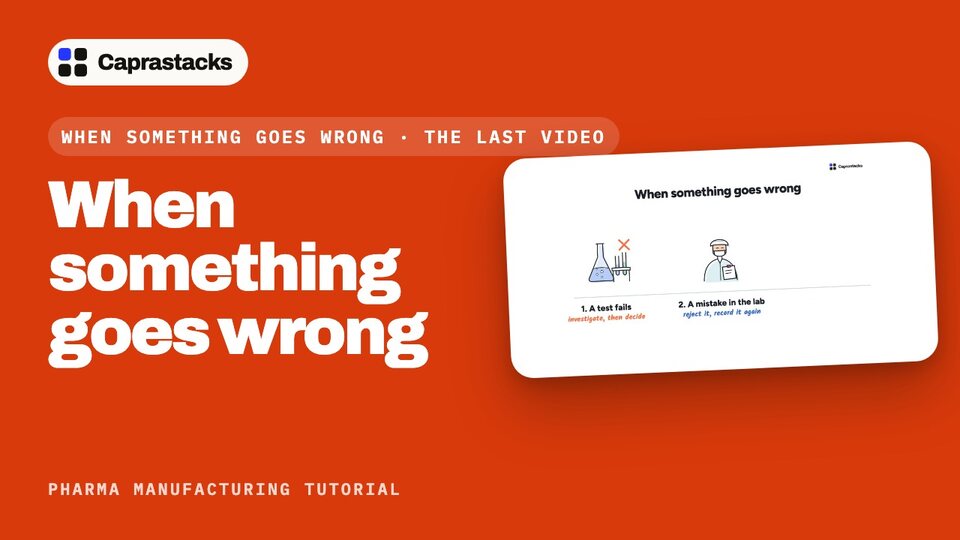
When something goes wrong
What to do when a test fails or someone types a wrong number, then what your batch cost, and the reports.
In 3 points
- 1 A failed test opens an investigation.
- 2 Reject a typing mistake, and record it again.
- 3 See what your batch cost, and the reports.
Chapters
Press one to jump thereRead the words
What goes wrong (0:00) This is the last video about manufacturing. It shows what to do when something goes wrong. A test fails, or someone types a wrong number. At the end, we look at what your batch cost, and at the reports.
A test fails (0:15) Chapter one: a test fails. We bought two new lots of paracetamol. Hamid tests the water in lot RM-0006, and types 0.9 percent. The limit is 0.5, so the box warns him straight away. When he records it, the app opens an investigation by itself: OOS-0001. OOS means out of specification.
Phase I: the lab checks its work (0:46) The lot is not thrown away yet. First, the lab checks its own work. This is Phase I. Faisal, the QC manager, opens the investigation. He writes what he checked: the sums, the chemicals, the machine and the sample. He finds no mistake in the lab, so he opens Phase II.
Phase II: test again (1:07) In Phase II, the lab tests again. Hamid repeats the water test: 0.88 percent. It fails again. The first result is never changed or deleted. The new one is added beside it. Faisal writes what he found: two drums arrived with torn liners, and the powder took in damp. He closes the investigation: the result is confirmed.
Quality rejects the lot (1:33) Now Usman, the head of quality, decides on the lot. The box gives three choices. Release means it can be used. Hold keeps it aside while something is checked. Reject means it can never be used. Usman picks Reject, writes why, and signs.
Send it back to the supplier (1:52) The rejected powder goes back to the supplier. Open Purchase, then Purchase returns, and press New debit note. Pick Sunrise Chemicals and the paracetamol, then choose lot RM-0006. Type the quantity, 99.99 kilograms, at the price we paid. Save it. The stock leaves, and we owe Sunrise 179,982 rupees less.
A typing mistake (2:23) Chapter two: a mistake in the lab. On the second lot, Hamid types the assay as 100.9. The printout says 99.9. Both pass, so nothing warns him. But a second person checks every result. Faisal compares it with the printout, and presses Reject. He picks the reason, A typo in the figure, and adds a note.
Record it again (2:49) The wrong result stops counting. But it stays in the lot's history, with Faisal's name and reason. The test goes back to To record, and Hamid records it again: 99.9.
When the wrong number fails (3:03) What if the wrong number fails? Here, 99.9 went into the water box by mistake. A failing result opens an investigation, and it can never be rejected. So Faisal checks the lab's work, and this time he finds the mistake. The machine's log has no water test for this sample. He picks Clear lab error, and writes the evidence. The investigation closes, and the result is marked invalid. It stays on the record, but it no longer counts. Hamid does the water test properly: 0.2 percent. All four results pass and are checked, so Usman releases the lot.
Every problem on one list (3:45) Every problem stays on one list. Open Manufacturing, then Quality, then Deviations and OOS. Both investigations are here: one confirmed, and one invalid.
What the batch cost (4:00) Chapter three: costs and reports. Open batch B-0002, and press Cost sheet, beside its cost. The batch cost 323,138 rupees, for 1,940 boxes. That is 166.57 rupees a box. Below, every material, every piece of packaging, and the labour, each on its own line.
Yield and loss (4:30) Manufacturing, then Reports, opens Yield and loss. For each product: what it was meant to make, what it made, and what was lost. Our boxes reached 99.5 percent.
How strict the rules are (4:44) And under Settings, then Rules, you choose how strict the app is. Off says nothing. Warn asks for a reason. Block stops the user.
The end (4:56) That is the end of the manufacturing videos. You set up your factory, made your first batch, sold it, and saw what to do when something goes wrong. Thank you for watching.