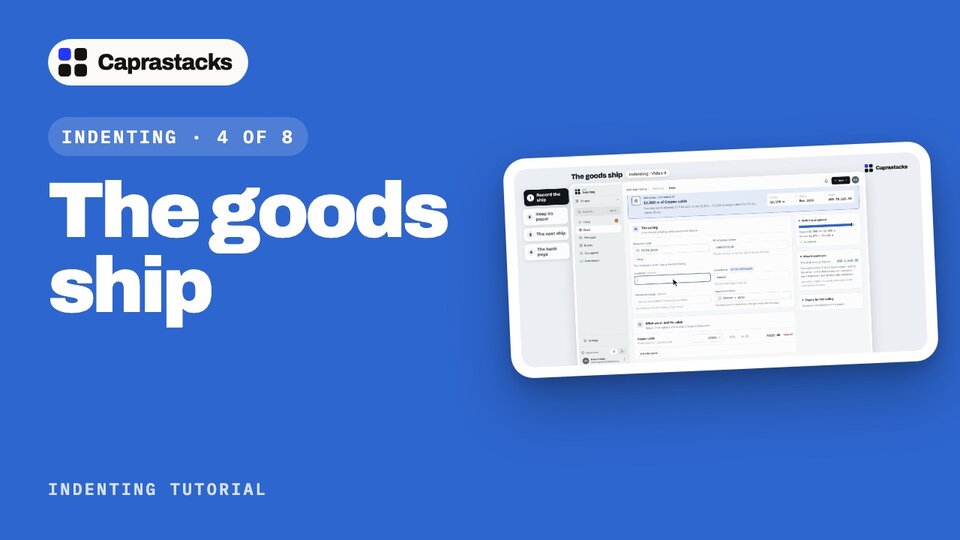
The goods ship
The goods sail, sometimes on more than one ship. Record each ship, keep its bill of lading, and mark when the bank pays the seller.
In 3 points
- 1 Record each ship; your commission is worked out on what really shipped.
- 2 Keep the bill of lading with its deal.
- 3 A second ship that carries more than the indent allows, and why the app asks for a reason.
Chapters
Press one to jump thereRead the words
What happens in real life (0:00) The LC is open. Now the cable leaves China. First, here is what happens in real life. Halberd loads the cable onto a ship. The shipping line gives Halberd a paper called the bill of lading. It proves the goods are on board, and the day the ship sailed. Halberd takes that paper to its bank. The bank checks it against the LC, and pays Halberd. And each ship that sails earns you commission. Sometimes the goods go on more than one ship. Each ship is one shipment. In the app, you do three things: record each ship, keep its paper, and mark when the bank pays. Let's follow our cable, step by step.
Record the ship (0:36) Click "Deals" in the menu on the left, then the deal. The box at the top always shows the next step. Now it says: record the shipment. Click "Record shipment". This page records one ship. The blue box at the top shows what's still to ship: all twelve thousand five hundred metres. It also shows how much more or less the indent allows: five percent. Now copy the sailing from the bill of lading. When did it sail? Pick the day printed on the bill of lading. Then type the bill of lading number. It's at the top right of the paper. Loaded at is the port it left from. Here, Shanghai. Unloaded at is already filled in from the indent: Karachi. Below, the cable is filled in with everything still to ship. But this first ship carried only six thousand metres. So change it to six thousand. Click "Save shipment 1". Back on the deal, the app has worked out your commission for this ship: seven hundred and fifty dollars. That's two percent of the thirty-seven thousand five hundred dollars that shipped. The next step now says to book it. We'll do that in the next video. Further down, under "Shipments", you see six thousand of twelve thousand five hundred metres shipped. The rest will follow on the next ship.
Keep its paper (1:48) Each ship comes with papers. In set-up, we asked for the bill of lading on every shipment. So under "Documents", shipment 1 now has a bill of lading waiting. Halberd emails you a copy. Click "Answer". What came of it? It came, so keep "Received". The day it came is today. Add the file: a PDF or a photo of the bill of lading. Click "Record". Now it's ticked as received, and the file is kept with the deal. Click its name to open it any time.
The next ship (2:17) Soon after, the rest of the cable sails on a second ship. Under "Shipments", click "Record shipment" again. This time the blue box shows six thousand five hundred metres still to ship. Fill in the sailing as before: the day, the bill of lading number, and the port. This ship carried seven thousand five hundred metres. So type seven thousand five hundred. Click "Save shipment 2". The app stops you here. Together, the two ships carried thirteen thousand five hundred metres. The indent allows up to thirteen thousand one hundred and twenty-five. So the app asks why. Northshore agreed to take the extra, so type that as the reason. The reason is saved with your name and the time. Click "Continue with this reason". Shipment 2 is recorded. Its commission is worked out on what really shipped: nine hundred and thirty-seven dollars fifty.
The bank pays (3:08) With both ships gone, Halberd hands its papers to its bank. Let's mark that on the deal. Click the "LC & payment" step at the top. Northshore's LC pays at sight: the bank pays as soon as the papers arrive. On the right, "What happens to an LC" lists its four stops. The bank opened it, and changed it once. We did both last time. Now click "The papers went in", pick the day, and click "Record it". When Halberd tells you the bank has paid, click "The seller was paid". These are only marks on the deal, so anyone can see where things stand. Nothing goes into your books. Two ships sailed, the bill of lading is kept, and the seller is paid. Now you can ask Halberd for your commission. That's the next video.